Interdisciplinary workshop
Shared Autonomy.
Human-Centered Lab Automation
A meeting to exchange knowledge between fields, on how to share laboratory tasks between humans and machine. How to implement autonomous systems, where pitfalls emerge, and what comes next.
For physics, materials science, chemistry, biology and related fields.
·Saarbrücken
- What works
- What does not
- What comes next
Attendance is free, but we cannot cover travel or accommodation for participants.
- Location
- Saarland University, Saarbrücken, Germany
- Format
- Three days of invited talks, lab tours and a networking dinner
- Language
- English
Supported by


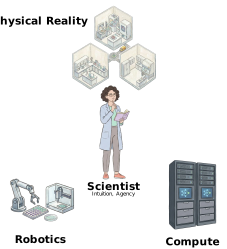
Scientific research is rapidly shifting from manual experimentation to automated and autonomous discovery. Despite its promise, fully “lights-out” laboratories face two hurdles: the reality gap of primitive and fragmented physical interfaces, and the lack of meaningful human integration.
This workshop focuses on closing that gap through shared autonomy, experiments driven jointly by researchers and automated systems. We are convinced human expertise remains essential in automated laboratories, but that collaborative space needs to be deliberately designed.
We bring together people across physics, materials science, chemistry and biology who are building and operating automated and autonomous experiments. We leave autonomous hypothesis generation and pure data evaluation to standard AI-for-Science events, and focus on the interface between software and machines. The plan is to discuss robotic orchestration, instrument interoperability, and how humans and machines coexist in a laboratory. We want to discuss what works, what was attempted, and what failed.
The three-day schedule contains talks from academia and industry with enough time left for conversations and coffee.
Talks will be recorded (where permitted) and published after the event.
Where is Saarbrücken?
Saarbrücken sits at the geographic and thematic intersection of the major European automation efforts. We sit at the border of Germany, a two-hour train ride from Paris, next to Luxembourg. We love the diversity that happens when different fields and different countries work together to improve the state of the art.
Topics
- Closing the physical loop: sample logistics, handling and environmental constraints
- Robotic orchestration of experiments and robust scheduling
- Instrument interoperability and integrating legacy hardware
- Human–robot interaction in the laboratory
- Reproducibility of physically executed experiments
- Negative results: failed integrations, unnecessary automation. Lessons learned.
Confirmed Speakers
More participants will be announced as invitations are confirmed.
Programme
A rough outline for now — the detailed session schedule will follow closer to the event.
Day 1 Wednesday, 11 November
- 09:00 Check-in opens
- 11:00 First talk
- 17:00 End of day
Day 2 Thursday, 12 November
- 09:00 Talks resume
- 16:00 End of sessions
- 19:00 Workshop dinner
Day 3 Friday, 13 November
- 09:00 Talks resume
- 13:30 Lunch
- 14:15–15:00 Closing: what next
- 15:00-17:00 Mingle and drinks
Organisers
Samuel Gyger
Workshop chair
Head of ALPS
Assistant Professor of Physics, Saarland University
Works on quantum optics, integrated photonics and precision nanofabrication, with a focus on physical lab automation using robotic actuators and tightly integrated hardware. Represents the physics perspective of the workshop.
Alvaro Banderas
Co-chair
Head of the Accelerated Research Foundry
INM – Leibniz Institute for New Materials
Comes from microbiology and synthetic biology, and heads the Accelerated Research Foundry, where design–build–test–learn cycles accelerate the discovery of engineered living materials. Represents the synthetic biology and materials science perspective.